Spray, Grip and Glare: Staying Steady When Gosport Turns Wet
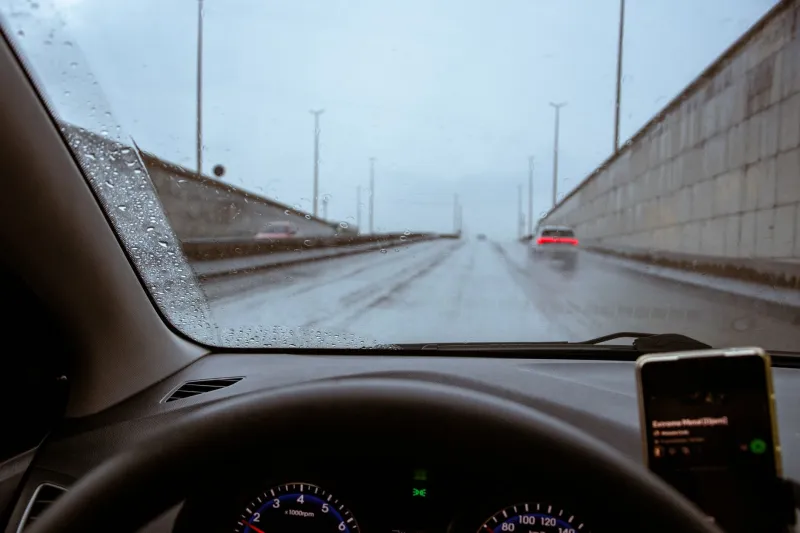
Rain in Gosport rarely arrives like a Hollywood storm. More often it's a grey, persistent drizzle that turns the A32 glossy, fills the gutters near Brockhurst, and makes every roundabout feel a little more crowded. For a learner, that can be enough to turn an ordinary lesson into a white-knuckle one. The good news is that wet-weather driving isn't a separate skill you either have or don't. It's a set of small adjustments — and most of them start before you turn the key.
Before You Turn the Key: A Two-Minute Rain Routine
You don't need a mechanic's checklist. You need a pause. When you get into the car and the windscreen is already speckled, take two minutes to set yourself up.
Start with the wipers. Put them on the right speed for the rain — not the fastest setting just because you're nervous. If they smear rather than clear, tell your instructor; worn blades are a small thing that makes a big difference to visibility.
Next, lights. In heavy rain, dipped headlights help you be seen as much as see. Not fog lights unless visibility is genuinely down to around 100 metres — they're for fog, not for a gloomy Tuesday on Fareham Road.
Then demist. Front screen, rear screen, mirrors. A clear view is the whole game. If your breath is fogging the glass, you're probably tense; turn the fan up and take a slow breath.
Finally, check your feet. Wet shoes on pedals can feel vague. It's not a safety crisis, but it's worth noticing before you pull away. Say to yourself, or to your instructor: 'I'm going to take this one gently.' Naming it out loud takes some of the sting out of the nerves.
The Gap That Grows: Following Distance in the Wet
The two-second rule is the one most learners know. In rain, it needs to become at least four seconds — and more if you're behind a lorry or a van throwing up spray.
Pick a fixed point ahead: a road sign, a lamppost, a bridge. When the vehicle in front passes it, count 'one thousand and one, one thousand and two...' If you reach the marker before you've finished, you're too close. Ease off. There's no prize for keeping up.
On the A32 towards Fareham, traffic can bunch up quickly when the surface is wet. If someone behind you is sitting close, resist the urge to speed up to please them. Keep your own gap ahead and let them wait. A tailgater is annoying; a tailgater plus a short gap in front is a lesson you don't need.
Seeing and Being Seen: Lights, Wipers and Spray
Spray is the thing that surprises learners most. A lorry or a bus can throw up a cloud that briefly blanks your view. The instinct is to brake hard. The better move is to have already planned a bigger gap so the blank moment doesn't become a panic.
If you're behind a large vehicle, drop back. If you're alongside one, don't linger. Either hang back and stay out of the spray, or overtake decisively when it's safe and legal. Sitting in the middle lane of a dual carriageway in someone's wheel-spray is the least relaxing place to be.
Also think about being seen. Dipped headlights, as above. Wipers that actually clear. A clean windscreen inside and out — grime on the inside turns low sun into a glare festival. And if the rain stops but the road is still wet, keep your lights on for a bit. The surface doesn't dry instantly.
Braking Without the Jolt: Smooth Inputs on the A32
Wet tarmac rewards smoothness. Think of the pedals as dials, not switches. Brake earlier and more gently. Accelerate progressively. Steer with your fingertips rather than sawing at the wheel.
On the A32, standing water often gathers near the kerb after heavy rain. Give it space where you safely can. If you do hit a puddle, keep a light grip, ease off the accelerator, and avoid braking hard. Aquaplaning — where the tyres briefly skate on water — is rare but startling. The recovery is less dramatic than it feels: gently lift off, keep the wheel steady, and let the tyres find the road again.
Roundabouts need a special mention. Peel Common can feel like a spray tunnel when traffic is queuing. Approach a little slower than you would in the dry, use the extra time to look for gaps, and don't let a helpful wave from another driver tempt you into a gap you haven't checked yourself. Wet paint markings and manhole covers can be slippery, especially when you're turning.
Glare, Junctions and the Gosport Grey
After rain, the sun sometimes appears at exactly the wrong angle. Low glare on a wet road is genuinely difficult. Slow down. Use the visor. Keep the windscreen clean. If you can't see, you can't drive — and that's not a failure, it's physics.
At junctions around Stoke Road or Haslar, wet weather can make emerging feel tighter. Look twice, edge out slowly, and don't rush because someone behind you is impatient. A few seconds of hesitation is cheaper than a scrape.
The Debrief: What to Say After a Wet Lesson
When you pull up at the end, don't judge the whole lesson by how tense you felt. Pick one thing that went well. Maybe you kept a four-second gap on the A32 even when a van filled your mirror. Maybe you noticed the spray from a lorry early and dropped back. Maybe you simply drove in rain and didn't panic.
That's the win. You don't need to love wet weather. You just need to know you can handle it — one smooth brake, one generous gap, one calm breath at a time.