Circles Without the Spin: A Calm Learner's Method for Gosport Roundabouts
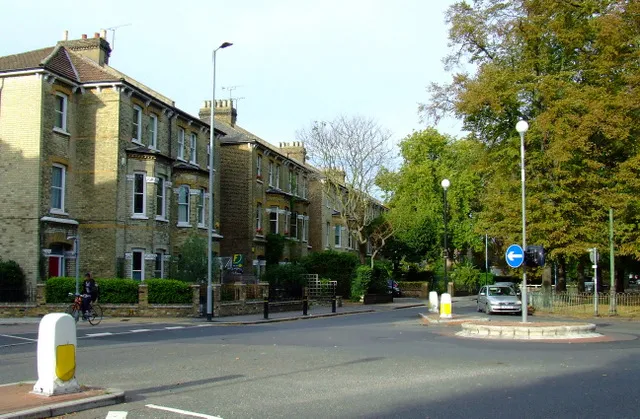
Photo: Thomas Nugent , CC BY-SA 2.0, via Wikimedia Commons
There's a particular kind of silence that fills a learner car as it approaches the little white circle painted on the road. It's the same silence you get at a difficult question in an exam, or when someone asks you to reverse into a space while three people watch. The mini roundabout has a reputation around Gosport that it honestly doesn't deserve. It is not a puzzle. It is not a race. And it is definitely not a place where you need to guess.
The trick — and it really is a trick rather than a talent — is to do your thinking before you arrive. Most of the stress learners feel at roundabouts comes from trying to gather information at the exact moment they need to act on it. If you can shift that work a few seconds earlier, the whole thing becomes ordinary.
The circle is not the decision point
Here's the mental shift that helps more than any amount of repetition: the roundabout itself is where you execute a plan, not where you make one. By the time your front wheels reach the give-way line, you should already know roughly who is coming, how fast they're moving, and whether you have a gap.
That means looking early. On the approach to a mini roundabout — say the ones you meet around Brockhurst, Elson or along the Stoke Road stretch — you want your eyes up and moving, not fixed on the tarmac two metres ahead. Scan the junction as it opens up. Check the road to your right, then the road ahead, then your mirrors if you're changing direction. It sounds like a lot, but it happens in a couple of glances once you're used to it.
If you can see the roundabout from a distance, start asking yourself quiet questions: Is there a car behind me? Is anyone waiting on the other arms? Is the road narrow here? Am I sure which exit I want? Those questions cost you nothing and buy you a huge amount of calm.
Slow enough to think, not so slow you stop
There's a Goldilocks speed for roundabouts and it's lower than most learners expect. You want to arrive slowly enough that you can stop safely if you need to, but not so slowly that you're creeping about and making everyone behind you irritable.
A useful rule of thumb is to be off the accelerator and covering the brake as you approach, especially at mini roundabouts where visibility can be tight. You don't need to brake hard. You just need to be ready. The car should feel like it's settling, not lurching.
At bigger roundabouts — the sort you meet heading towards Fareham or on the way to Lee-on-the-Solent — give yourself more time and more space. Same routine, bigger scale. Early mirror checks, a clear signal if you're turning, and a steady approach speed that lets you read the traffic rather than react to it.
Signals are information, not decoration
Indicate clearly and indicate early enough to be useful, but don't treat the indicator as a magic wand. A signal tells other people what you intend to do. It doesn't give you priority and it doesn't guarantee anyone will make room for you.
At mini roundabouts, a lot of learners signal left as they approach and then wonder why nobody lets them out. The signal is helpful, but the gap is what actually matters. Wait for a gap you're confident about. If the signal is on and the gap isn't there, keep waiting. Nobody sensible will think less of you.
And if you're going straight ahead — the second exit — you generally don't need to signal on the approach. A left signal as you pass the exit before yours is plenty. Keep it simple. Over-signalling can be as confusing as not signalling at all.
The gap is yours when you're sure, not when you're hopeful
This is the bit that separates a flustered roundabout from a calm one. Gap selection is a judgement, and judgements get better with practice. You are looking for a space that is genuinely large enough for you to move into without making another driver brake or swerve.
If you hesitate, that's fine. Hesitation is not a failure. Pulling out on a hopeful guess is a failure — or at least a risk you don't need to take. A paused learner at a give-way line is a normal sight in Gosport. A learner who has committed to a gap that wasn't there is a much less pleasant sight.
So give yourself permission to wait. Count to three if it helps. Breathe out. Look again. The traffic will clear. It always does.
When you take the wrong exit
It happens. You meant to go straight on towards Alverstoke and somehow you're heading off towards Privett Road instead. The important thing is what you do next: absolutely nothing dramatic.
Do not stop on the roundabout. Do not reverse. Do not slam on the brakes because you've spotted your error. Just keep going, take the exit you've ended up on, and find a safe place to pull over or turn around further down the road. A wrong turn is a thirty-second inconvenience. A panic manoeuvre on a roundabout is a genuine hazard.
Once you're clear, pull in somewhere sensible, reset, and rejoin your route. Your instructor won't be cross. If anything, taking the wrong exit calmly is one of the most useful skills you can demonstrate.
If you stall or freeze
Stalling at a mini roundabout feels enormous in the moment and looks completely unremarkable from the outside. Take a breath, put the clutch down, restart the engine, and carry on when it's safe. If someone behind you toots, let it go. Their impatience is their business, not your emergency.
If you freeze — that awful moment where your brain goes blank and your feet forget what they're doing — the safest thing is to stay still until you've reset. You are allowed to take a second. You are allowed to take five. The roundabout will still be there.
A short practice loop worth trying
When you're ready, ask your instructor to string together a few mini roundabouts in one lesson rather than treating them as one-off obstacles. A loop around the quieter residential junctions in Gosport, finishing with one larger roundabout, gives you repetition without overwhelm. The aim isn't to nail every gap first time. It's to make the routine feel familiar — look early, slow early, signal clearly, wait for a gap you trust.
Mini roundabouts stop being scary the moment they stop being surprising. And the way to make them unsurprising is simply to meet them slowly, calmly, and often. You'll get there. Most learners do, usually sooner than they expect.