Any Road, Any Day: Why Adaptable Driving Beats Memorising Gosport Test Routes
It is one of the first questions every learner asks: which route will the examiner take me on? It makes sense. A test feels less frightening when you can picture the roads ahead. But there is a quiet trap in treating the Gosport test route like a secret map. Routes change, traffic changes, and examiners are not obliged to follow the same sequence of turns your friend had last month. What actually carries you through is not recall. It is the skill of reading whatever road appears next.
Why a Memorised Route Feels Reassuring — Until It Doesn't
A known route gives you a script. Left at the lights, right at the mini-roundabout, watch for the bus, then back towards the test centre. There is nothing wrong with that familiarity. It can settle the nerves and help you notice how a particular junction behaves at 10am on a Tuesday.
The problem is that a script is brittle. Gosport is not a fixed set of turns. The ferry queue can spill back further than usual. A bin lorry can block a residential street. Roadworks can appear overnight. A school-run queue can turn a straightforward right turn into a slow, stop-start negotiation. If your confidence is tied to a memorised sequence, one unexpected diversion can feel like the whole test falling apart.
A better aim is to leave every lesson with habits that work on roads you have never seen. That is what an examiner is really looking for: not whether you know the route, but whether you can manage the road in front of you.
Gosport Is a Set of Road Types, Not a List of Turns
Once you stop thinking in route names and start thinking in road types, the town becomes much easier to read. Most of the challenges you meet on a Gosport test are versions of things you have already practised.
Ferry traffic and busy queuing roads
The ferry terminal area rewards patience and observation. Queues move in waves, not at a steady pace. The useful habits are simple: keep the exit clear, leave a gap ahead so you can see, watch for pedestrians weaving between vehicles, and resist the urge to follow the car in front too closely. If the traffic stops, stop. Do not creep forward just because the car behind is impatient.
Narrow residential streets
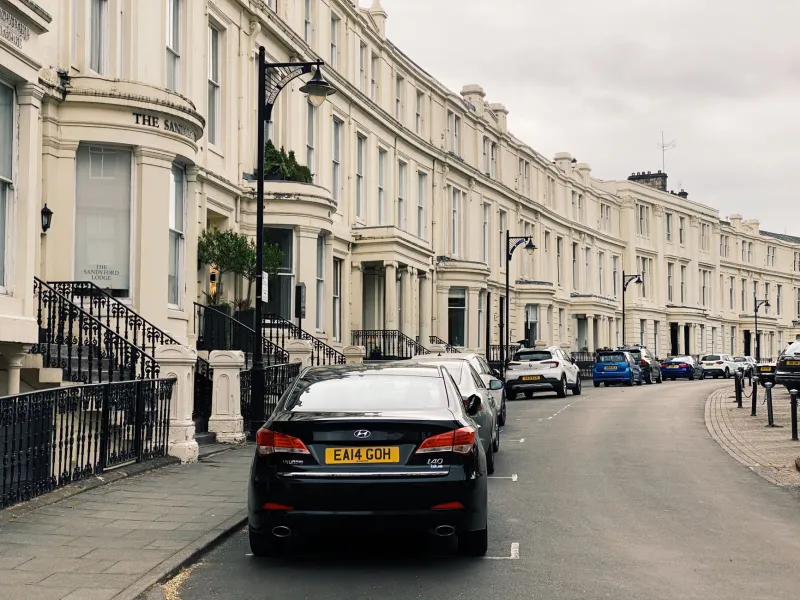
Streets around Alverstoke, Stoke Road and the older parts of town often ask you to share space. Parked cars, wheelie bins, delivery vans and oncoming traffic all compete for the same strip of tarmac. The calm approach is to slow early, choose your gap before you need it, and make eye contact with other drivers where possible. If someone gives way, check that it is genuinely safe before moving. A friendly wave is not a guarantee.
School-run queues
School streets have their own rhythm. For a short window, the road is full of children, parents, parked cars and last-minute door openings. The skill is not to rush the gap when it appears. It is to read the pavement as well as the road, watch for crossing patrols, and keep your speed low enough that a child stepping out is a moment, not a crisis.
These three road types repeat all over Gosport. Learn the principles behind them and you have prepared for far more than a single route.
The Three-Question Pause for an Unfamiliar Turn
When an examiner asks you to take a turn you have never taken, the instinct is to tense up. That is normal. The trick is to have a short routine that gives your brain something useful to do instead of panicking about the unknown.
Try this three-question pause. It should take seconds, not minutes.
- What is this road asking of me? Look at the width, visibility, speed of traffic, parked cars, pedestrians and road markings. Is this a road that wants 20mph and patience, or a clear road with good sightlines? Read it before you commit.
- Where is my safe space? Decide where you would go if something unexpected happened. Is there a gap to pull into? Is there room to stop? Is the lane position giving you an escape route? You are not looking for a perfect plan, just a safer one.
- What is my next simple action? Do not try to solve the whole road at once. Pick the next action: check the mirror, slow down, signal, change gear, hold your position. Then do it. After that, ask the three questions again if you need to.
This is not a long pause at the wheel. It is a mental checklist that keeps you looking, thinking and moving smoothly. Examiners are not impressed by memorised route knowledge. They are reassured by a learner who reads the road and makes sensible decisions.
Practise Adaptability on Purpose
You can build this skill in ordinary lessons. Ask your instructor to call turns at random rather than following a set loop. Narrate what you see: 'parked cars on the left, oncoming van, gap coming up'. Play the what-if game — what if that car pulls out, what if the lights change, what if the pedestrian steps back? It feels a bit awkward at first, but it trains your eyes to scan instead of stare.
Vary the time of day, too. A road at 11am is a different creature from the same road at 3.15pm. Wet weather, dusk and a busy Saturday morning all add useful experience. If you have watched route videos online, treat them as entertainment rather than homework. They can show you a junction, but they cannot teach you how to feel the road under your wheels.
What to Say to Yourself When Plans Change
If you take a wrong turn, or an examiner directs you somewhere unfamiliar, the calmest phrase in your head is: 'New road, same job.' You are still looking, steering, slowing and deciding. A missed turn is not a failed test. Provided you continue safely and follow the next instruction, the examiner will simply redirect you.
The test route is not really a secret. It is every road Gosport can throw at you, including the ones you have not seen yet. Prepare for the skill, not the script, and you will be far less rattled when the unexpected appears.